Dynamics of Cancer Cells under Pulsatile Flow in Curved Microchannels
Presentation slides from my talk at the 2025 International BioMechanics Conference in Irvine, CA.

Thien-Tam Nguyen is a Ph.D. candidate in Civil Engineering at North Dakota State University and has been a Graduate Research Fellow at Lawrence Berkeley National Laboratory. He earned his B.Sc. in Physics from Vietnam National University - University of Science. His research focuses on developing exascale high-performance computational frameworks for multi-scale simulations of blood flow dynamics, combining computational fluid dynamics with machine learning techniques. He has published in prestigious journals including Physics of Fluids, where his work was selected as an Editor's Pick, and a Cover Feature recognition from the Coalition for Academic Scientific Computation. His expertise spans high-performance computing, applied mathematics, biophysics and biomedical flow simulations. Thien-Tam Nguyen's contributions and work ethics have been recognized through multiple awards, including the APS Division of Fluid Dynamics Travel Award and the Innovative Engineer Award from Viettel Aerospace Institute. Beyond research, he served as a proud Bison Ambassador, representing NDSU in community engagement and outreach efforts.
University of California, Irvine
Physics of Fluids Journal
Coalition for Academic Scientific Computation
American Physical Society
Viettel Aerospace Institute
Vietnam National University - University of Science
University of California, Irvine
Physics of Fluids Journal
Coalition for Academic Scientific Computation
American Physical Society
Viettel Aerospace Institute
Vietnam National University - University of Science
High-fidelity Computational Fluid Dynamics simulations were performed and systematically coarsened to generate 72 cases with varying spatial and temporal resolutions. The Hankel DMD method was then used to identify dominant flow modes and instabilities within the aneurysm sac.
The results demonstrate that DMD analysis reveals unique patient-specific 3D flow structures independent of aneurysm geometry, and the energy pseudo-spectrum effectively captures flow dynamics even at low resolutions comparable to clinical imaging (CT or MRI). Aneurysmal hemodynamics can be categorized into 'laminarized flows' and 'transient dynamics' based on cumulative energy curves, offering a new quantitative tool that could significantly improve clinical rupture risk assessment.
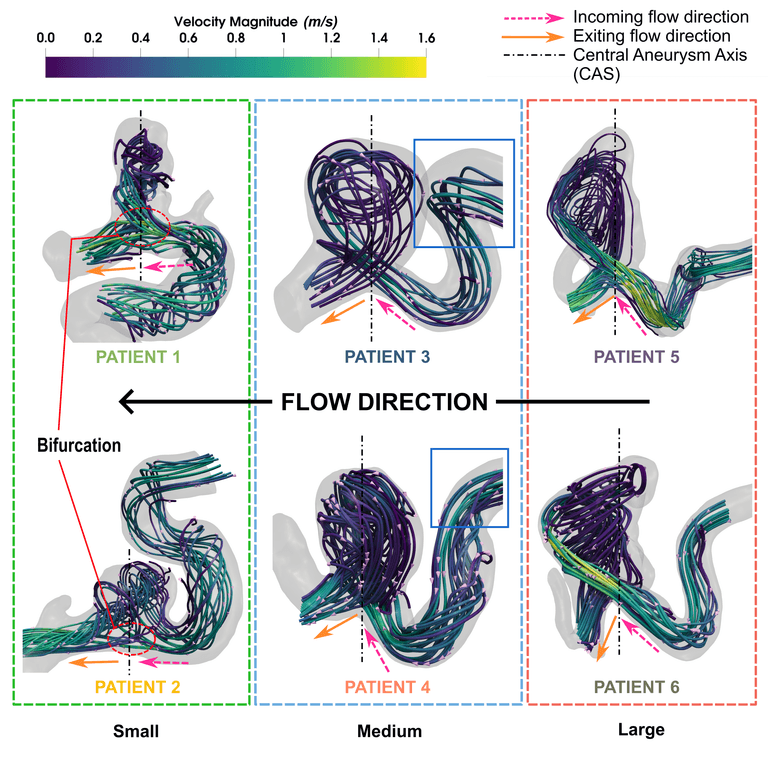

Presentation slides from my talk at the 2025 International BioMechanics Conference in Irvine, CA.
Presentation slides from my talk at the 18th US National Congress on Computational Mechanics (USNCCM18) in Chicago, IL.
Presentation slides from my talk at the 2024 APS Division of Fluid Dynamics Conference in Salt Lake City, UT